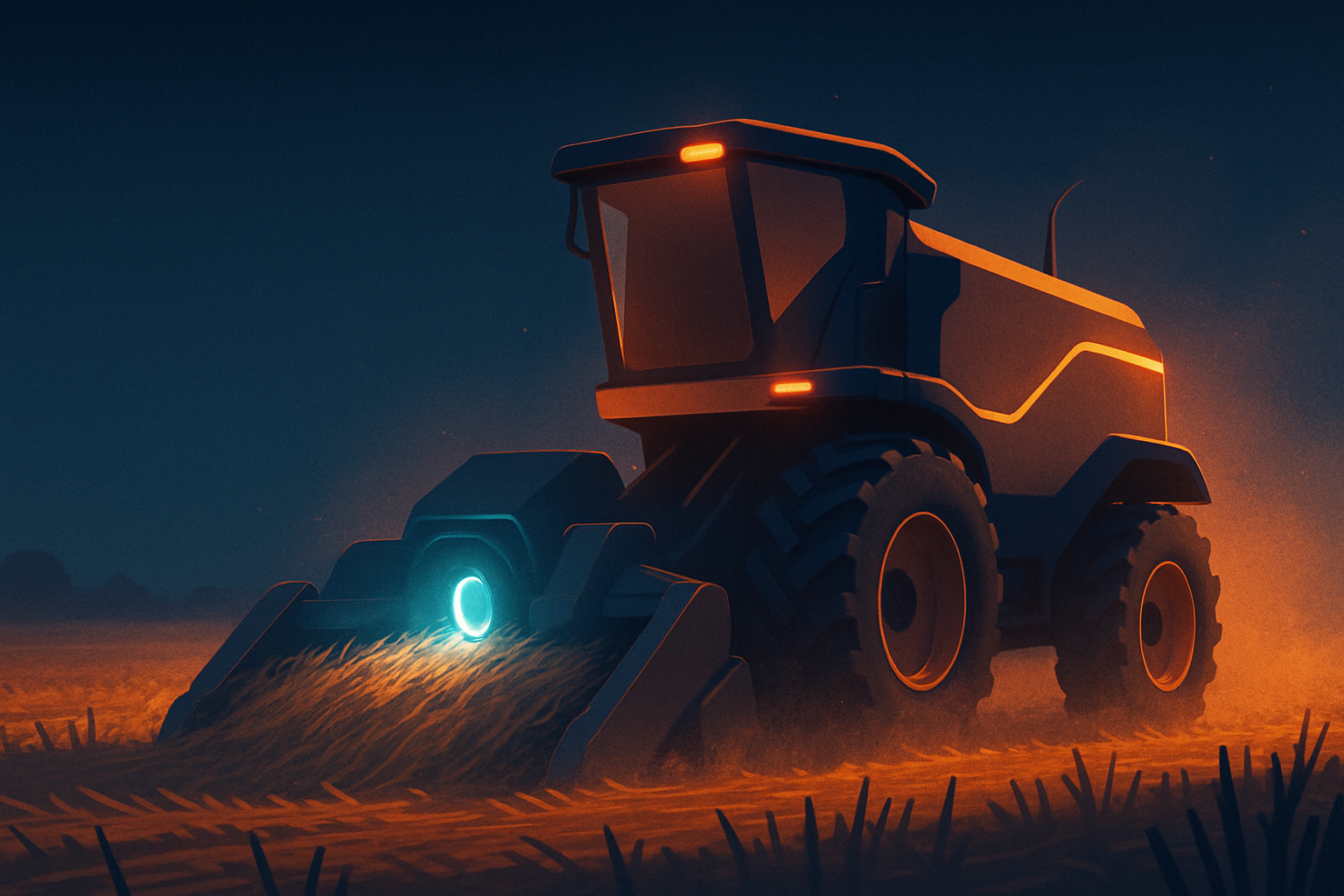
Most of Houston's robotics story runs through refineries, hospitals, shipyards, and the seafloor. Here's a different one: a Houston company built a machine that drives across a harvested farm field, vacuums up leftover corn or rice stalks, cooks them at 1,000°F, and lays the resulting carbon-rich char back down on the soil — all in a single pass.
What the Machine Does
Climate Robotics — now operating as Applied Carbon — has developed a mobile pyrolizer: an agricultural machine that converts crop residue into biochar in-field. It picks up field residue like corn, rice, and cotton stalks, chops it, and feeds it into a reactor that heats the biomass to roughly 1,000°F in a low-oxygen environment. That process, pyrolysis, breaks the material down into biochar and syngas rather than burning it.
The biochar goes straight back onto the field as a soil amendment, where it helps with soil acidification, moisture retention, and nutrient availability — improving yields and reducing nitrogen fertilizer needs. Because the carbon in biochar is stable, it also stays locked in the soil rather than returning to the atmosphere as the residue decomposes, which is what makes this a carbon-removal play as much as an agricultural one.
The engineering insight is doing it in the field. Biochar itself isn't new — the hard part has always been logistics: hauling bulky, low-density crop residue to a central processing plant and hauling char back out is expensive enough to kill the economics. Putting the reactor on a machine that drives to the residue eliminates the haul entirely.
The Funding and the Rollout
The company raised a $21.5 million Series A led by TO VC, with participation from Congruent Ventures and the Microsoft Climate Innovation Fund among others. The capital is aimed at deploying its biochar machines across Texas, Oklahoma, Arkansas, and Louisiana — a footprint that tracks the row-crop agriculture of the Gulf South rather than the Corn Belt, keeping the early rollout close to home.
Why It Belongs in Houston's Robotics Story
It's easy to file this under climate tech and move on, but it's a robotics story at heart: a large autonomous-capable machine, doing a complex physical-processing task, in an unstructured outdoor environment. Field robotics is one of the genuinely hard frontiers — dirt, dust, weather, uneven terrain, and no controlled factory floor to lean on.
It also broadens what Houston's robotics sector looks like. The region's automation expertise was built on energy and heavy industry, but that same competence — rugged machines doing hard physical work in unforgiving conditions — transfers naturally to agriculture. Applied Carbon is a case of Houston engineering being pointed at a field (literally) that the city isn't known for. Browse more of the region's robotics companies in our directory.
Based on company materials and Houston climate-technology trade coverage. Climate Robotics now operates as Applied Carbon.