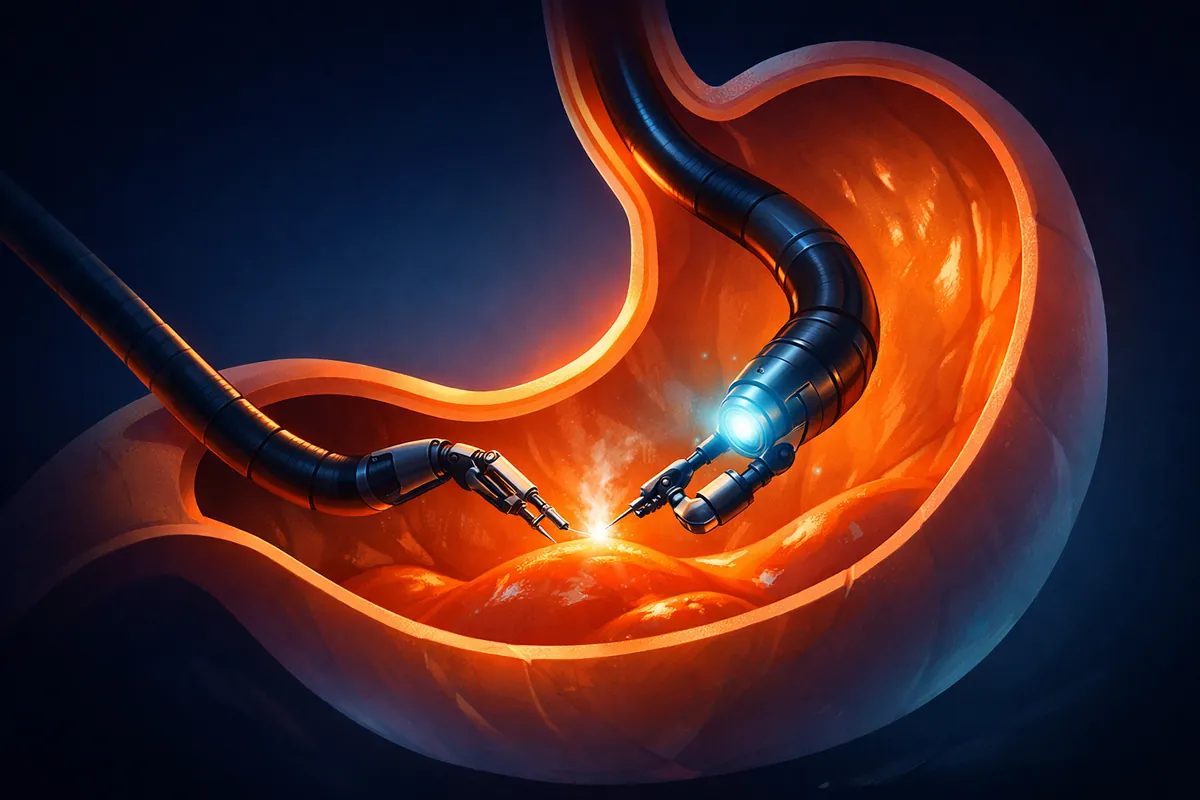
EndoQuest Robotics, the Houston company building a robot that operates from inside the digestive tract, has taken its system somewhere new. On November 5 it announced that surgeons completed two robotic gastric reconstruction procedures at The Panama Clinic in Panama City, working entirely through the patient's mouth.
The company calls them the world's first fully robotic transoral gastric procedures. That is EndoQuest's own claim; we have not seen independent confirmation.
What the Surgeons Did
The cases treated a known complication of Roux-en-Y gastric bypass, one of the most common weight-loss operations. Over time, the new connection between the stomach pouch and the small intestine can stretch, and patients can regain weight. Gastroenterologists already tighten that opening with an endoscopic technique called transoral outlet reduction. EndoQuest's version uses its Endoluminal Surgical (ELS) System: a flexible robot passed through the mouth that carries two independent instruments, letting the surgeon place full-thickness sutures with two "hands" instead of the single channel of a standard endoscope.
The cases were led by Dr. Todd Wilson, EndoQuest's chief medical officer and a professor of surgery at McGovern Medical School at UTHealth Houston, with Dr. Richard Altieri Pérez of The Panama Clinic as the local principal investigator. "We can bring basic surgical technique directly to the target, without external incisions," Wilson said. The release describes them as first-in-human cases; it does not give a study name or the dates of the procedures.
Why It Matters
Until now, the ELS System's clinical work has been in the lower digestive tract. Its pivotal U.S. trial, PARADIGM, tested the robot for removing precancerous lesions from the rectum and sigmoid colon, and finished enrolling in July. Showing the same platform working in the stomach widens what the company can pitch, from a niche procedure to a broader set of operations done without external incisions.
EndoQuest's board chairman is Dr. Fred Moll, co-founder of Intuitive Surgical, the company behind the da Vinci robot. He said what he saw in Panama "represents a major expansion in the clinical reach of robotic surgery."
The company is also developing a further step: robotic gastric plication, which folds the stomach from the inside to reduce its volume, a true natural-orifice operation. In a preclinical study at Brigham and Women's Hospital, the company reports a mean gastric volume reduction of 70%.
Where Things Stand
The ELS System is investigational and is not cleared for sale in the United States. EndoQuest says it is preparing a De Novo request to the FDA and is targeting a U.S. launch in 2027, subject to authorization. The system was accepted into the FDA's Safer Technologies Program, which is meant to speed review of devices that improve on existing treatments.
For Houston, EndoQuest is one of the clearest examples of the Texas Medical Center producing a robotics company that could take on a global market. We follow it, along with XCath and the rest of the local field, in our guide to surgical robotics at the TMC.
Based on EndoQuest Robotics' announcement of November 5, 2026 (Business Wire) and reporting by Medical Product Outsourcing. The "world's first" description is the company's.