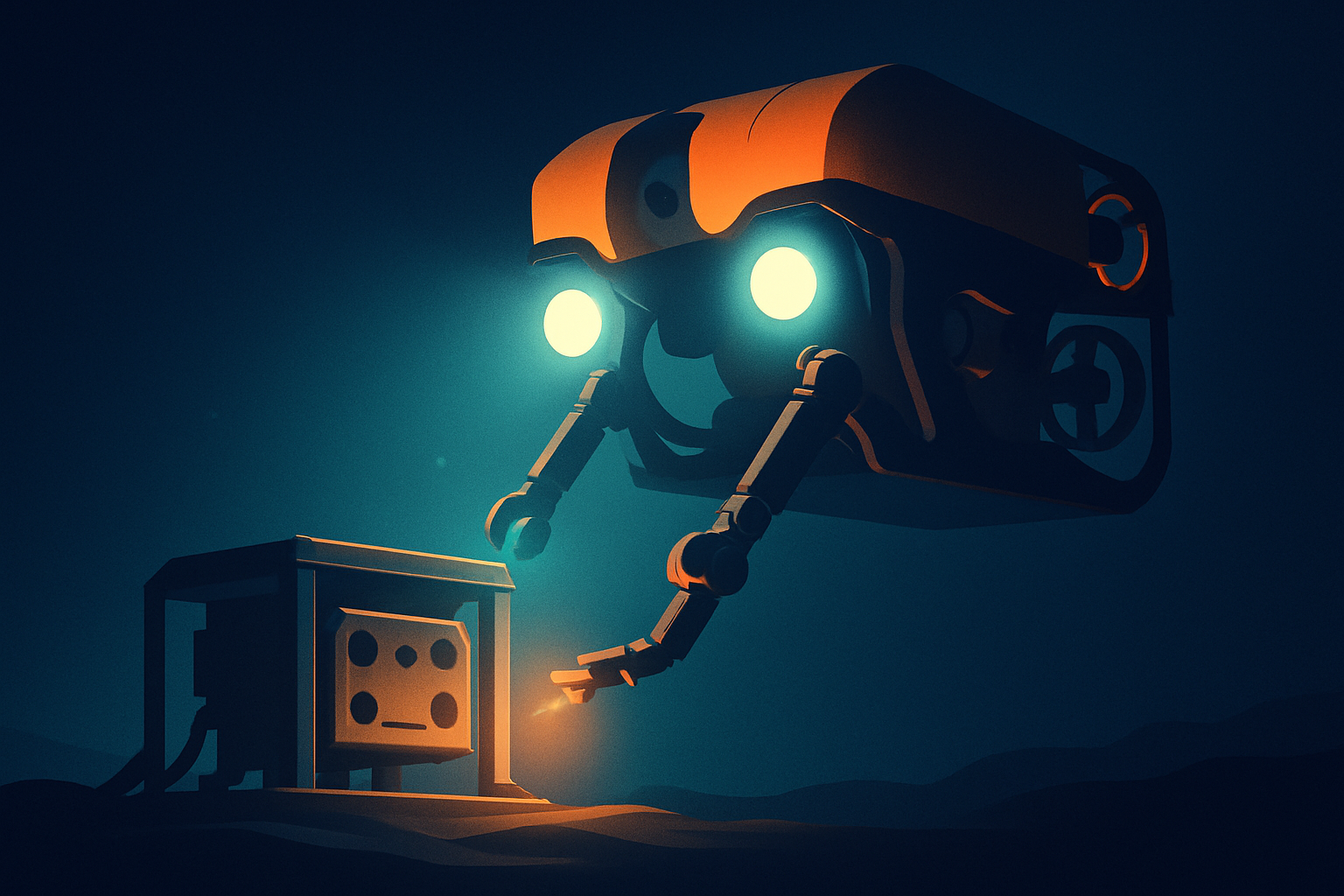
At depths where sunlight doesn't reach and water pressure would crush a human diver in seconds, the Gulf of Mexico's offshore oil and gas infrastructure is inspected, maintained, and repaired by robots. Remotely operated vehicles — ROVs — are not emerging technology in this context. They are standard, essential operating equipment, and the Gulf of Mexico runs one of the largest ROV fleets on earth.
Houston is the nerve center of this industry. The companies that operate ROVs, the companies that build them, the engineers who design them, and the researchers pushing the technology forward are concentrated in and around the Houston metro. Understanding how ROVs work is understanding how offshore energy actually functions.
What Is an ROV?
A remotely operated vehicle is an underwater robot connected to a surface vessel or platform by a tether — a cable that carries power, control signals, and data simultaneously. The tether is both the ROV's lifeline and its primary operational constraint: it limits range, creates drag, and can become entangled in subsea structures. But it also enables real-time control and high-bandwidth video and sensor data transmission that untethered systems can't match.
ROVs come in several classes based on size and capability:
- Observation-class ROVs — small, lightweight, primarily used for visual inspection. Cameras, lights, and basic sensors. No manipulation capability. Can be deployed from a small vessel.
- Work-class ROVs — the heavy equipment of the subsea world. 2,000-6,000 kg, equipped with hydraulic manipulator arms capable of torquing bolts, opening valves, cutting cables, and handling tools. These are the robots that actually do physical work on subsea infrastructure.
- Trenching and burial ROVs — specialized vehicles for pipeline installation and burial operations. Not inspection tools — construction equipment.
A typical offshore work-class ROV deployment involves a dedicated ROV support vessel, a team of ROV pilots and technicians working in shifts around the clock, and an operations control room with multiple screens displaying live video feeds, sonar data, and vehicle telemetry. The pilot controls the ROV using joysticks and software interfaces while watching live video from the vehicle's cameras — from a surface location that may be 1,500 meters directly above the robot.
What ROVs Do in the Gulf
The Gulf of Mexico's offshore infrastructure includes more than 40,000 miles of active pipeline, hundreds of production platforms and floating production systems, and deepwater facilities operating at water depths exceeding 3,000 meters. All of it requires regular inspection and periodic maintenance. ROVs are the primary tool for all of it.
Pipeline inspection is among the most common ROV tasks: surveying pipeline routes for free-span conditions (where the pipe is unsupported and vulnerable to fatigue), corrosion, damage from anchors or fishing gear, and current-induced movement. Inspection ROVs carry multibeam sonar, acoustic profilers, and high-definition cameras to generate detailed records of pipeline condition.
Structure inspection applies to wellheads, manifolds, christmas trees, risers, and platform foundations — all the hardware that connects subsea wells to surface production facilities. Inspecting these structures requires both visual and contact methods: ROVs can carry ultrasonic thickness measurement tools, cathodic protection probes, and cleaning brushes to remove marine growth before measurement.
Intervention work is where work-class ROVs earn their keep. Opening and closing subsea valves, torquing flange bolts, installing and removing equipment, deploying and recovering tools — these tasks require manipulation capability that only work-class vehicles provide. In deepwater fields, a single ROV intervention to open a stuck valve might prevent a production shutdown worth millions of dollars per day.
AUVs: The Untethered Alternative
Autonomous underwater vehicles (AUVs) operate without a tether, navigating pre-programmed survey routes and recording data for later analysis. What they gain in range and maneuverability, they give up in real-time control and the ability to do physical work. AUVs are primarily used for survey work — mapping pipeline routes, generating bathymetric charts, and conducting acoustic surveys of large areas that would take an ROV weeks to cover.
The frontier of subsea robotics is combining AUV-class autonomy with ROV-class manipulation capability. That's the problem Nauticus Robotics, headquartered in Webster, Texas, is working on. Their Aquanaut vehicle is designed to transit to a work site autonomously like an AUV, then reconfigure into a manipulation-capable work vehicle to perform tasks without a dedicated support vessel — a combination that, if it scales commercially, could dramatically reduce the cost of routine subsea intervention work.
Houston's Role in the ROV Industry
The Gulf of Mexico is the training ground where the global ROV industry developed its operating practices, built its workforce, and refined its technology. Most of the major ROV service companies — Oceaneering International (headquartered in Houston), Fugro (North America operations in Houston), Saipem (Gulf of Mexico operations) — have deep Houston roots. The city's workforce includes thousands of ROV pilots, technicians, marine engineers, and subsea project managers whose skills are deployed globally.
University of Houston's Energy Research Park runs dedicated offshore robotics programs, developing the next generation of subsea automation technology in collaboration with industry partners. The combination of operational expertise concentrated in Houston-based companies and research capacity at UH creates an ecosystem that keeps the city at the center of subsea robotics development even as the technology evolves toward greater autonomy.
What's Coming Next
The ROV industry is in the middle of a technology transition driven by three forces: the push toward reduced operational costs (fewer vessel days per inspection), the increasing availability of AI-based image analysis for automated anomaly detection, and the maturation of AUV technology to the point where full survey autonomy is commercially viable.
The endpoint of that transition — the fully autonomous subsea inspection and intervention vehicle that requires no support vessel and no continuous human supervision — is still years away from routine commercial deployment. But the direction is clear, the investment is real, and the companies working on it are largely Houston companies. The Gulf of Mexico, which drove the original development of ROV technology, is likely to be where autonomous subsea robotics first proves itself at commercial scale.