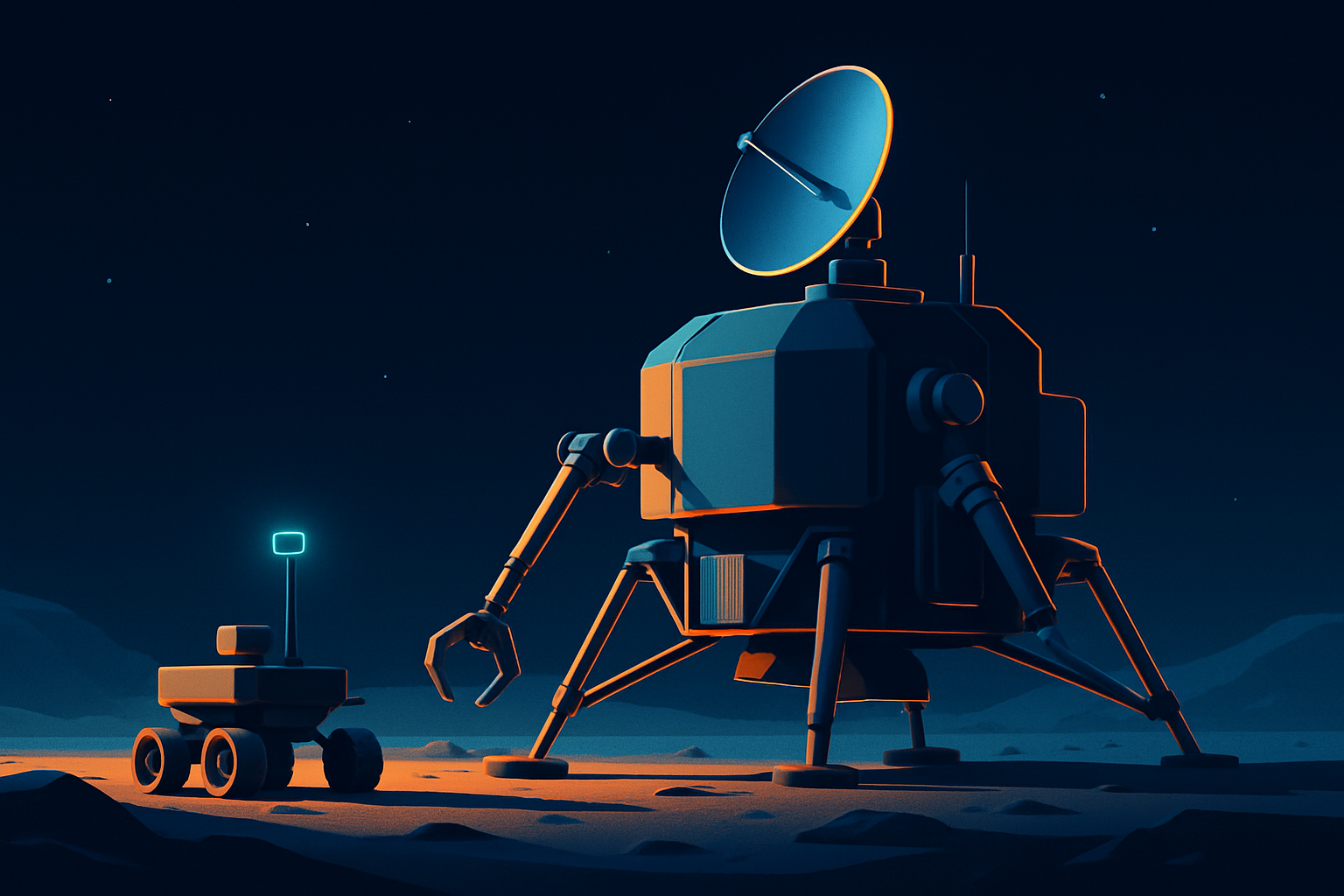
Intuitive Machines — the Houston-headquartered company that has put commercial landers on the surface of the Moon — is doubling down on the robotics that make those missions possible. The company is significantly expanding its dedicated mechanisms and robotics operation, standing up a new Center of Excellence to build the robotic hardware at the heart of its lunar program.
What's Being Built
The expansion centers on a 69,000-square-foot facility branded the Super Cislunar Robotics Assembly Building (Supa-CRAB) — a Mechanisms and Robotics Center of Excellence. The buildout, slated for fall 2026, includes equipment for in-house Assembly, Integration and Test (AI&T): the rigorous process of putting space hardware together and proving it will survive launch and operate in the lunar environment, where there's no opportunity for repair.
It's backed by a $1 million Build Our Future Grant from Maryland Governor Wes Moore, supporting the expansion in Anne Arundel County, Maryland. Intuitive Machines first established operations in Maryland in 2021 and has now expanded there five times, with its robotics facility officially opening in 2024 — a steady scaling that reflects how central robotic mechanisms have become to the company's missions.
"This collaboration shows how industry, state programs, and education can reinforce one another," said CEO Steve Altemus, framing the investment as part of building "a permanent path to long-term lunar operations."
The Robotics Behind the Missions
This isn't a speculative R&D lab — the team builds flight hardware that has already flown. The robotics group has produced mechanisms for the company's Nova-C landers and its IM-1 and IM-2 lunar missions. IM-1 made Intuitive Machines the first commercial company to soft-land a spacecraft on the Moon, a milestone that put a Houston company in the history books.
The pipeline ahead is dense with robotics work: the IM-3 Rover Deployment Mechanism (the system that will release a rover onto the lunar surface), panoramic camera systems, a Main Engine Gimbal (the mechanism that steers the lander's thrust during descent), and the Altus-1 data relay satellite. Each of these is a precision robotic or electromechanical system that has to work perfectly, the first time, hundreds of thousands of miles from any technician.
The Houston Connection
While this particular expansion lands in Maryland, Intuitive Machines is fundamentally a Houston company. It is headquartered at the Houston Spaceport — the commercial spaceport at Ellington Airport that has become a hub for the city's growing space-industrial sector — and it recently secured a $180 million NASA Commercial Lunar Payload Services (CLPS) award for lunar delivery missions.
That makes Intuitive Machines one of the anchors of Houston's space-robotics ecosystem, alongside the deep robotics expertise concentrated at NASA's Johnson Space Center just down the road. The two represent the public and commercial sides of the same regional strength: Houston's decades-long accumulation of knowledge about building machines that work in space.
Why It Matters
The expansion is a useful signal of where commercial space is heading. As lunar missions move from one-off demonstrations toward a sustained cadence — multiple landers, rovers, and relay satellites — the bottleneck becomes manufacturing: the ability to build flight-qualified robotic mechanisms reliably and repeatedly. Standing up a dedicated Center of Excellence with in-house assembly and test capability is how a company industrializes that process.
For Houston, Intuitive Machines is a reminder that the city's space identity is no longer just about mission control and astronaut training — it's about companies designing and building the robotic hardware that explores other worlds. The mechanisms being developed for the Moon are among the most demanding robotics projects anywhere, and a Houston company is leading them. Explore more of the region's robotics landscape in our directory, or read our latest coverage.
Reporting based on coverage by InnovationMap. Original story: innovationmap.