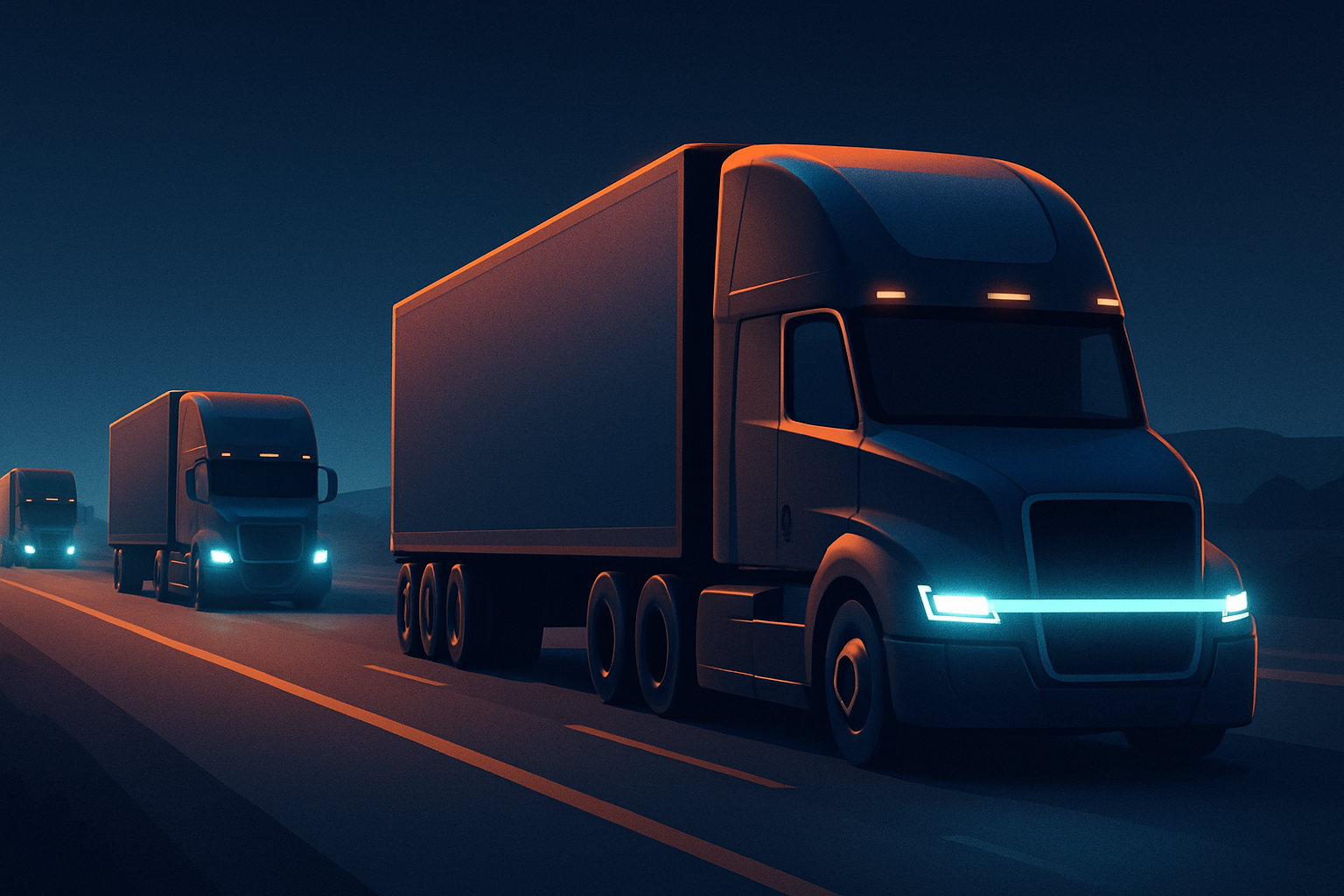
Somewhere on Interstate 45 between Dallas and Houston right now, an 80,000-pound semi truck is hauling commercial freight with no one driving it. Not a person with their hands off the wheel — no driver at all. After years of pilots and promises, autonomous trucking has become real, commercial, and routine in Texas. The question worth asking is why it happened here.
The State of Play in 2026
Aurora Innovation is the furthest along. After launching commercial driverless operations in Texas, Aurora now runs fully driverless trucks — no safety operator at the wheel — across a growing network of lanes including Dallas-Houston, Fort Worth-El Paso, El Paso-Phoenix, Fort Worth-Phoenix, and Laredo-Dallas. In May 2026 it signed a deal with distribution giant McLane to haul loads driverless between Dallas and Houston. As of its second-quarter 2026 report, Aurora had logged nearly 440,000 driverless miles since launch, with a 100% on-time record and zero collisions attributed to the Aurora Driver, across lanes including Dallas–Laredo, Fort Worth–Phoenix, and a Permian-region run between Midland and Monahans on I-20. It is targeting more than 200 driverless trucks by the end of 2026.
The economics are improving alongside the mileage. Aurora's second-generation hardware kit is engineered for a million miles of service life, is expected to cut hardware cost by more than half, and extends its FirstLight lidar to a one-kilometer range — which the company frames as more than 34 seconds of reaction time at highway speed. A third-generation kit, developed with PACCAR and AUMOVIO, is slated for production in the second half of 2027.
Kodiak Robotics is the other major player with deep Texas roots, already running on the Dallas-Houston corridor. Kodiak finished the first quarter of 2026 with 28 customer-owned driverless vehicles and more than 23,500 paid driverless operating hours logged. It now runs what it describes as the largest fleet of driverless Class 8 trucks in the Permian Basin — hauling for oilfield customers on private and lease roads, a lower-risk proving ground than public interstates — and is targeting a long-haul highway launch in the second half of 2026. Others — including Waymo Via and TuSimple — are working to expand in the same market. Texas has effectively become the live arena where the autonomous-trucking industry proves itself.
Why Texas, Specifically
Several factors line up here in a way they don't anywhere else in the country:
- The freight triangle. Dallas-Fort Worth, Houston, and San Antonio form one of the densest freight corridors in North America, connected by wide, well-maintained interstates (I-45, I-10, I-35). Short, high-volume, repeatable lanes between major distribution hubs are exactly what early driverless trucks do best.
- Laredo. The Laredo border crossing is the largest inland port in the U.S. by trade value, funneling enormous volumes of Mexico-U.S. truck freight straight into the Texas highway network.
- Regulation. Texas permits autonomous commercial vehicles on public roads under a comparatively clear, permissive framework — a decisive advantage over states with restrictive or uncertain rules.
- Weather and terrain. Long stretches of flat, dry, sunny highway are far friendlier to sensor-based autonomy than snow and ice. Texas offers a lot of good-weather highway miles.
How Driverless Trucking Actually Works
The dominant model is hub-to-hub. Autonomous trucks handle the long, monotonous highway middle of a journey — driving terminal-to-terminal along the interstate — while human drivers handle the complex first and last miles in city traffic and at loading docks. This plays to the technology's strength (highway driving is more predictable than urban streets) and sidesteps its hardest problems.
The trucks themselves are robots in every sense. A redundant sensor suite — cameras, radar, and lidar — builds a real-time 3D model of the road and surrounding traffic. A self-driving software stack handles perception, prediction, and path planning, with redundant braking, steering, and power systems so that any single failure has a safe fallback. The truck operates within a defined "operational design domain" — specific highways, conditions, and speeds it's certified for — rather than going anywhere a human could.
Why Now — and Why It Matters
The economics are compelling: a driverless truck can run far more hours per day than a human driver constrained by hours-of-service rules, and the long-haul trucking industry faces persistent driver shortages and high turnover. Removing the driver from the highway leg addresses both the labor constraint and the cost structure at once.
It also raises real questions — about jobs, liability, and safety regulation — that Texas is now working through in real time, ahead of most of the country. With driverless trucks hauling actual cargo on public highways, the state has become the place where the rules of the road for autonomous freight are being written.
Where Houston Fits
Houston is an anchor of the whole system. As the southern point of the freight triangle, the home of the busiest U.S. port by tonnage, and the logistics hub for the Gulf Coast's enormous energy supply chain, Houston is both a primary destination and origin for autonomous freight. The Dallas-Houston lane is the flagship corridor for both Aurora and Kodiak precisely because of the volume of goods moving between the two metros.
A self-driving truck is, fundamentally, the same kind of machine as the inspection drones and subsea robots reshaping Houston's energy sector — a perception-planning-control system acting on the physical world. Its arrival on Texas highways adds a major, consumer-economy-facing pillar to the region's autonomy story. Explore the autonomous-vehicle companies operating here, including Kodiak Robotics and Waymo, in our directory.