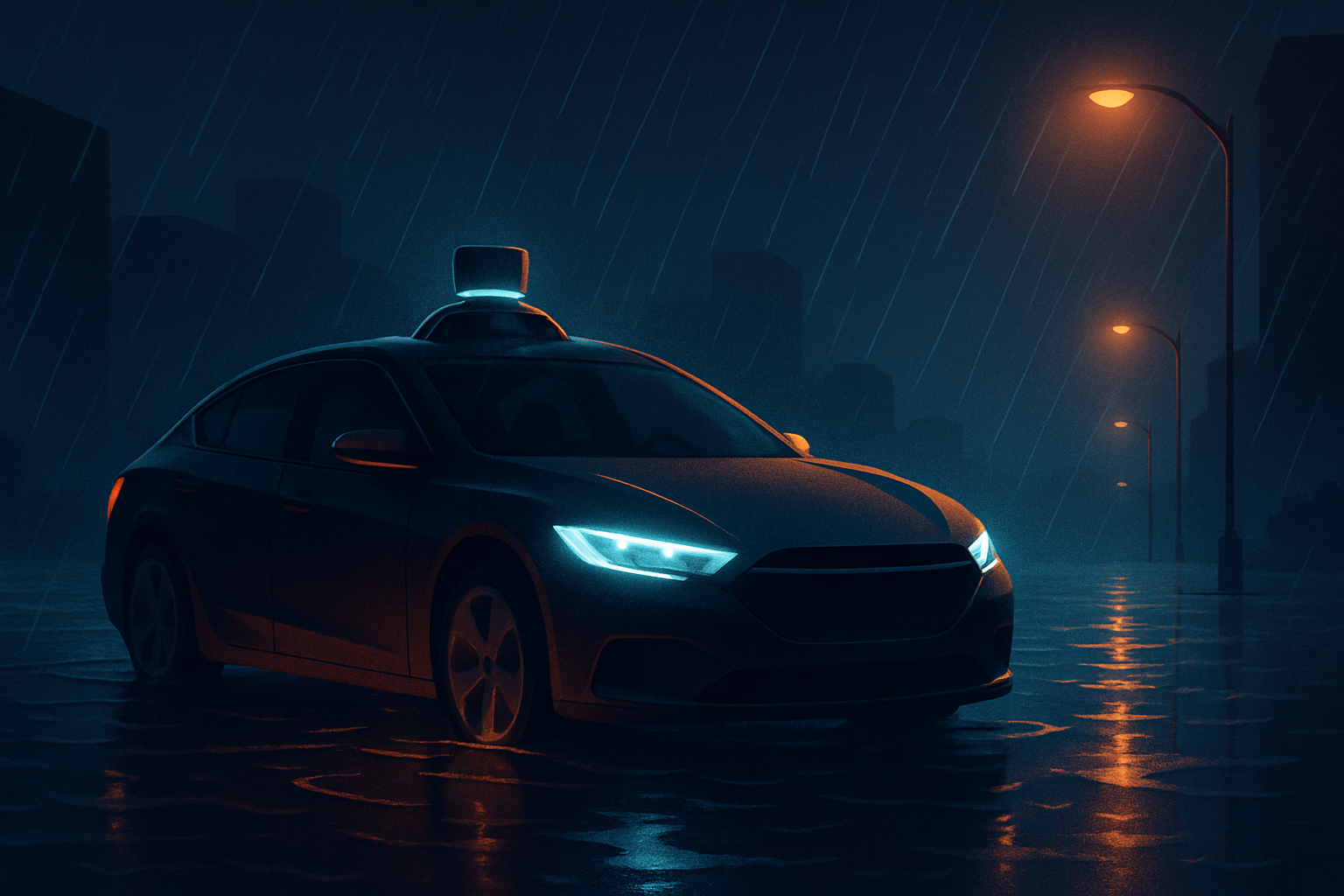
Waymo's Houston expansion — announced with considerable fanfare as the company positioned itself for World Cup crowds at NRG Stadium — has run into a problem that no amount of autonomous miles can paper over: the vehicles cannot reliably detect flooded roads, and Texas storms are unforgiving.
On May 21, an unoccupied Waymo robotaxi in Atlanta drove into a flooded street during intense rainfall and sat stranded for nearly an hour before being recovered. The incident was filmed and circulated widely. It was not the first such event — Waymo had already issued a software recall the previous week following an earlier flood incident in San Antonio — but the Atlanta video made the issue impossible to ignore.
What Happened
The core problem is straightforward: Waymo's vehicles use National Weather Service alerts (flash flood warnings, watches, and advisories) as an input to prepare for flooding risk. But the Atlanta storm on May 21 produced rainfall so rapidly that streets flooded before any official weather alert had been issued. The vehicle's software had no trigger to route around the water — and it didn't.
In response, Waymo suspended service in Houston, Dallas, Austin, and San Antonio, citing forecasted severe weather across Texas. The pause was described as precautionary, but the underlying issue — an incomplete software remedy — is the real story. Waymo acknowledged at the time of its recall that it had not finished developing a "final remedy" for flooded road detection. The interim update merely "placed restrictions at times and in locations where there is an elevated risk of encountering a flooded, higher-speed roadway." That restriction system failed in Atlanta.
The Houston Implications
Houston's relationship with flooding is not a seasonal footnote. The city sits on flat coastal plain, receives some of the highest annual rainfall totals of any major U.S. city, and has experienced catastrophic floods in 2001 (Tropical Storm Allison), 2015 (Memorial Day floods), 2016 (Tax Day floods), and 2017 (Hurricane Harvey). Flash flooding during ordinary thunderstorms is a recurring reality — not a rare edge case.
For an autonomous vehicle operating in Houston, flood detection is not an optional capability. It is a baseline safety requirement. The fact that Waymo deployed and then expanded in Houston while still carrying an open software recall on exactly this issue is a question the company will need to answer more directly than it has so far.
As of this writing, Waymo has not confirmed when Houston service will resume. NHTSA has stated awareness of the situation and said it would take appropriate action if necessary.
The Broader Picture
The pause does not mean autonomous vehicles are not ready for Texas. It means one company's flood detection software was not ready for Texas, and the company expanded before fixing it. The distinction matters. Kodiak AI has been running commercial driverless freight on the Dallas-Houston I-45 corridor without comparable incidents. Aurora is operating on the same route. Those programs have different operational envelopes — highway long-haul, not urban street driving — but they demonstrate that autonomous vehicle technology can be deployed responsibly in Texas conditions when the capabilities match the environment.
Waymo's World Cup ambitions for Houston are not necessarily over. But the path back to expansion runs through a flood detection fix that actually works — and Houston's weather will not wait for the software team's schedule.