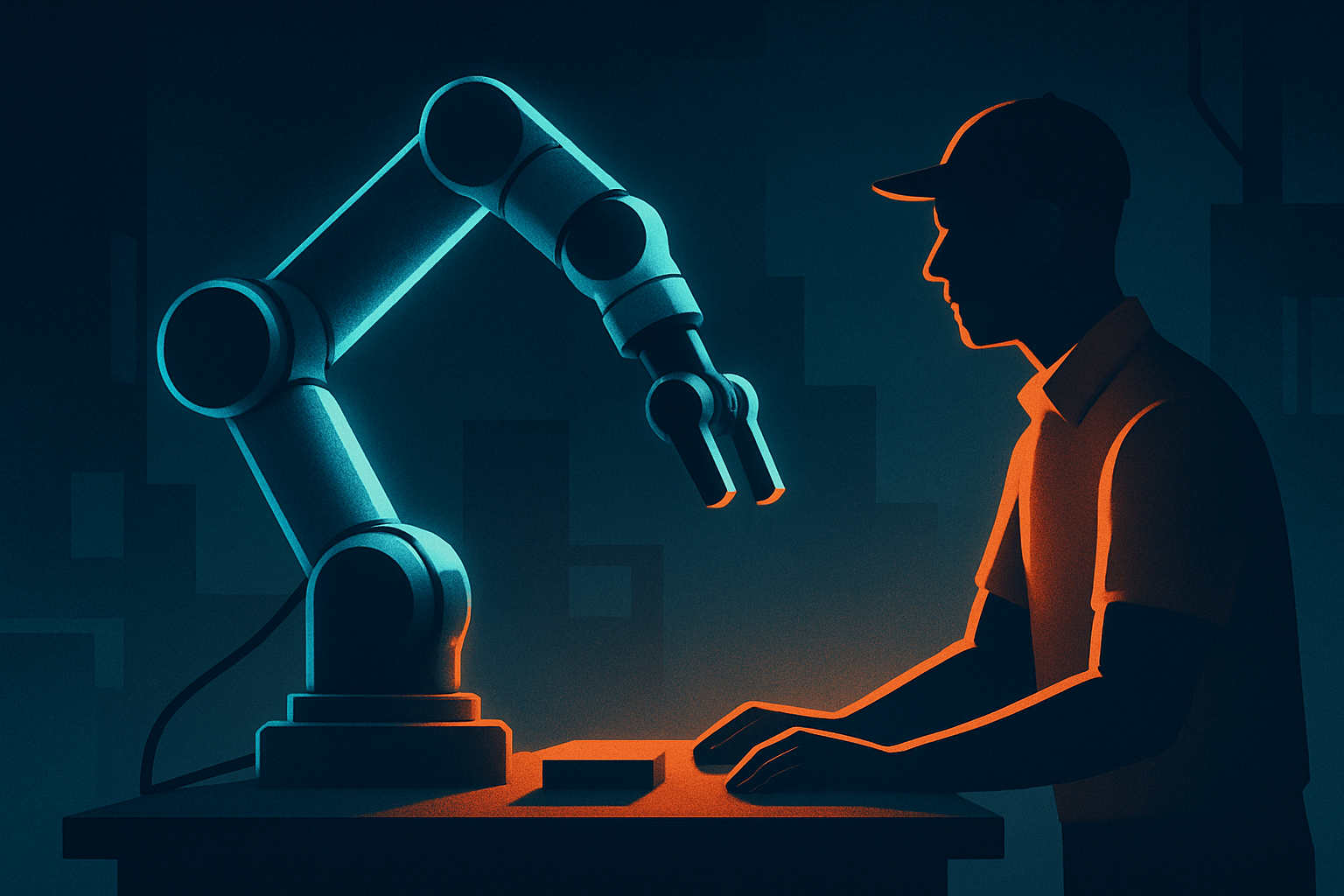
For most Texas manufacturers, the word "robot" still conjures an image of a giant arm swinging behind a steel safety cage — expensive, complicated, and bolted to the floor of a big plant. The collaborative robot, or cobot, was invented to break that image. It's the most accessible on-ramp to automation that exists, and for small and mid-sized manufacturers across Houston and Texas, it's often the right first step. Here's what you need to know.
What a Cobot Actually Is
A cobot is a robot arm designed to work alongside human operators in a shared space, without the cage. Traditional industrial robots are powerful and fast, but precisely because of that they have to be fenced off — getting hit by one is dangerous. Cobots are engineered from the ground up to be safe around people: they're lighter, they move within force and speed limits, and they're built to detect contact and stop.
That single difference — no cage required — changes the economics and the footprint of automation. A cobot can sit on a workbench next to an employee, hand off parts, and be moved to a different task next week. It doesn't require redesigning your floor around a safety perimeter.
The Safety Rules (and a Critical Caveat)
Cobot safety is governed by an international standard, ISO/TS 15066, which sets out the biomechanical limits — the maximum forces and pressures a robot can apply to a human without causing harm. (As of the 2025 update, those collaborative requirements have been formally absorbed into the broader ISO 10218-2:2025 robot-safety standard.) The limits are concrete: roughly 150 newtons for transient contact, lower for clamping situations, derived from testing on human subjects to map the threshold of pain.
But here's the caveat every manufacturer needs to understand: a cobot is not automatically safe just because it's a cobot. The robot arm may be inherently safe, but the moment you put a sharp tool, a heavy part, or a pinch-point fixture on the end of it, the application changes. A cobot wielding a deburring blade or handling a 20-pound casting still requires a proper risk assessment, and may still need light curtains, area scanners, or speed-limited zones. The safety lives in the whole application, not just the arm.
What Cobots Are Good At
Cobots excel at the repetitive, ergonomically punishing tasks that are hard to keep humans in:
- Machine tending — loading and unloading CNC machines, presses, and injection molders
- Palletizing — stacking boxes and parts, one of the most common and highest-ROI applications
- Pick-and-place and light assembly — moving, sorting, and assembling small parts
- Welding — cobot welding has exploded in popularity for small job shops that can't justify a full robotic weld cell
- Quality inspection — moving a camera or sensor through a repeatable inspection routine
Most cobots handle payloads in the range of a few kilograms up to roughly 20-35 kg for the larger models — enough for a huge share of real manufacturing tasks.
Why They Fit Texas Manufacturers
Several things make cobots a particularly good fit for the Houston and Texas manufacturing base — which skews toward energy equipment, fabrication, machining, and mid-sized job shops:
- Lower cost and faster payback. A cobot cell is a fraction of the cost of a traditional caged system, and many pay for themselves within a year or two.
- Flexibility. Cobots are redeployable — run a palletizing job this month, move it to machine tending next month. That suits high-mix, lower-volume shops.
- Labor pressure. Persistent shortages of skilled machine operators and welders make a tool that automates the repetitive parts of those jobs immediately valuable.
- Easier programming. Many cobots can be "taught" by physically guiding the arm through a motion, lowering the skill barrier to deployment.
The Honest Limitations
Cobots are not a universal answer. They're slower than caged industrial robots — the speed limits that make them safe also cap their throughput, so for high-volume, fixed, high-speed production a traditional robot still wins. Their payloads are limited. And, as noted, the safety story gets more complicated the moment the task involves sharp tools or heavy loads. The right move is almost always a proper application assessment before buying.
How to Get Started in Houston
You don't have to figure this out alone. Houston has experienced robot OEMs and integrators who deploy cobots for exactly these applications — including ABB, Industrial Robotics of Texas, and Automation X. The right partner will run a feasibility assessment, identify whether a cobot or a traditional robot fits your task, and handle the integration and safety validation.
For more on choosing and scoping an automation partner, see our guide on how to find robotics help in Houston, or browse the platform categories in use across the region in the Showroom. To explore local companies, visit our directory.