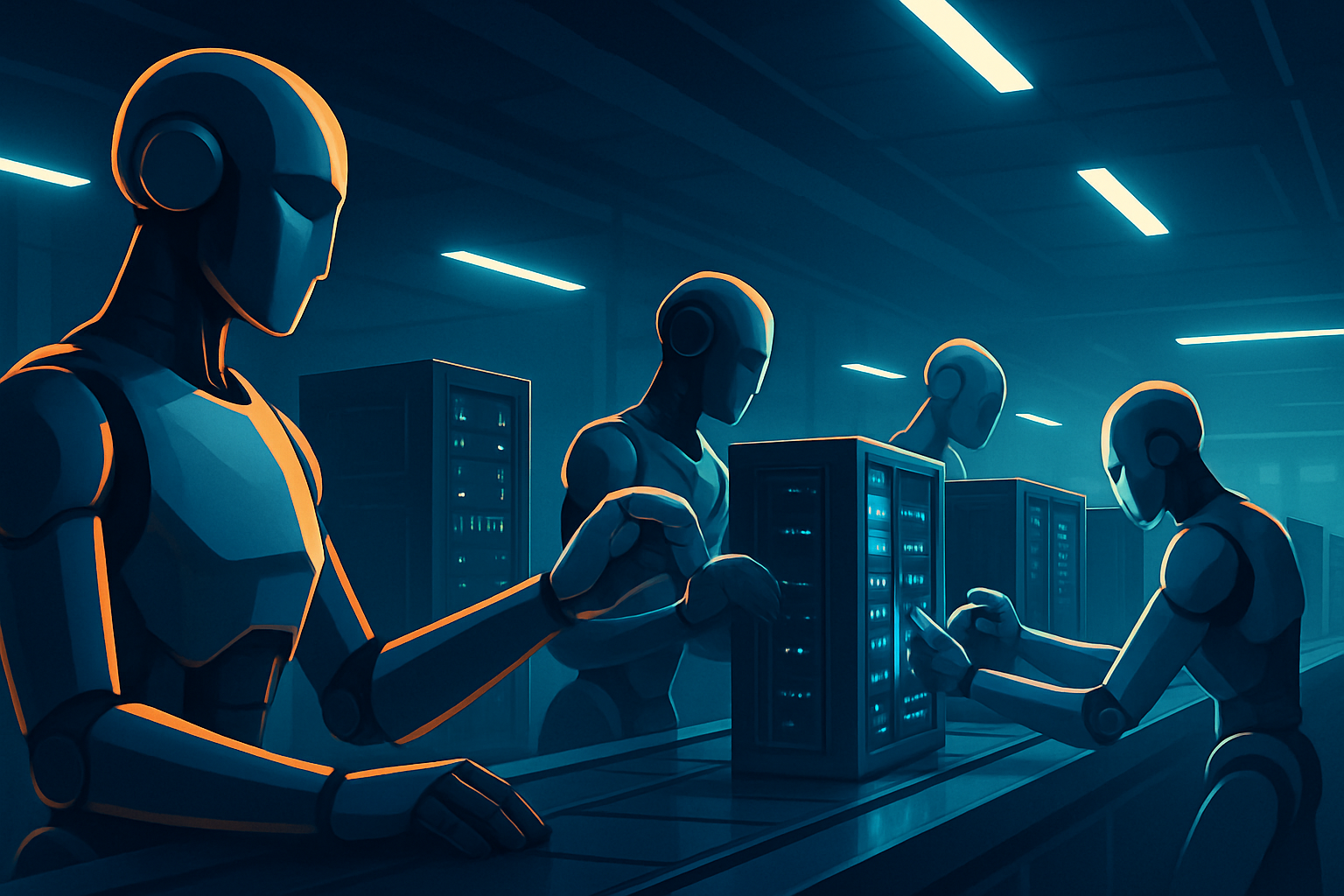
There's a striking loop taking shape on a factory floor in Houston: humanoid robots are being put to work building the very AI servers whose chips will train and run the next generation of AI — including the AI that controls humanoid robots. Foxconn, the world's largest electronics manufacturer, is deploying humanoid robots at its Houston plant that produces Nvidia's AI servers, in one of the first serious industrial humanoid deployments in the United States.
What's Happening
Foxconn's Houston facility is one of the plants building Nvidia's flagship AI server systems — the racks of GPUs that power data centers across the AI industry. Now that plant is set to become one of the first anywhere to integrate humanoid robots powered by NVIDIA's Isaac GR00T platform directly into the production line. The move was announced during one of Nvidia's developer conferences and marks a significant escalation in the Foxconn–Nvidia collaboration on factory automation, with deployment beginning in 2026.
The robots are designed to autonomously execute high-precision, repetitive industrial tasks: pick-and-place, screw fastening, and material handling — exactly the kind of fiddly, monotonous work that's hard to keep humans engaged in and hard to automate with traditional fixed machines.
Why Humanoids, and Not Just More Arms
It's a fair question: factories have used robotic arms for decades. Why put a human-shaped robot on the line? The answer is flexibility. A traditional industrial robot is bolted in place and programmed for one repetitive motion behind a safety cage. A humanoid built on a platform like Isaac GR00T is designed to perceive parts, adapt to changes on the line, work safely around people, and — critically — switch tasks through software rather than physical re-tooling.
That adaptability is the whole thesis of the humanoid manufacturing bet. A server assembly line changes constantly as product generations turn over. A robot that can be updated in software to handle a new task, in a workspace built for humans, is far cheaper to redeploy than a fixed automation cell that has to be physically rebuilt. Nvidia's stack for this — Isaac GR00T for the robot's 'brain,' FoundationPose for perceiving object position, Isaac Sim for training in simulation, and Jetson Thor as the onboard compute — is designed to let robots learn skills from real factory scenarios and refine them through both simulation and on-site iteration.
Why It Matters That This Is in Houston
This deployment lands in Houston as part of Foxconn's broader push to scale AI-server production in the United States, alongside facilities in Wisconsin and California. For Houston specifically, hosting one of the country's first humanoid-integrated production lines is a meaningful marker. The city's manufacturing base — long anchored in energy equipment and heavy industry — is now on the leading edge of the humanoid-manufacturing era.
It also puts a global validation stamp on a bet Houston companies are already making. Persona AI, the Houston-based humanoid startup founded by former NASA roboticists, is building industrial humanoids for heavy industry like shipyards. When Foxconn and Nvidia choose a Houston plant to prove out humanoid manufacturing, it reinforces that the region isn't just adopting this technology — it's becoming a place where industrial humanoids are developed and deployed.
The Workforce Question
Any story about humanoid robots on a factory floor raises the obvious question about jobs. The framing from Foxconn and Nvidia is augmentation: the robots take the repetitive, ergonomically punishing tasks so human workers can focus on higher-skill work — and someone has to program, supervise, maintain, and troubleshoot the robots themselves. That's a different skill set than traditional line work, and it's exactly the kind of automation-adjacent training that Houston institutions like Houston Community College are building programs around.
The honest reality is that this is early. Deploying humanoids at production scale is genuinely hard — reliability, safety, and throughput all have to be proven before the robots are doing meaningful volumes of real work rather than pilot demonstrations. But the direction is set, and Houston is one of the places where it's being figured out for real.
The Bigger Picture
For most of the past decade, the accessible face of factory automation has been the collaborative robot — a single lightweight arm working next to a person. The humanoid is the next, more ambitious step: a general-purpose machine that can, in theory, do many of the physical tasks a human line worker does, and be reassigned in software. Foxconn's Houston deployment is one of the first large-scale tests of whether that thesis holds up in a real, high-volume factory.
Whether it fully delivers or not, it's a remarkable thing to be happening in Houston: humanoid robots, on a local production line, building the computers that power the AI revolution. Explore more of Houston's robotics ecosystem in our directory.
Based on announcements from Foxconn (Hon Hai) and NVIDIA and subsequent reporting on the Houston deployment.