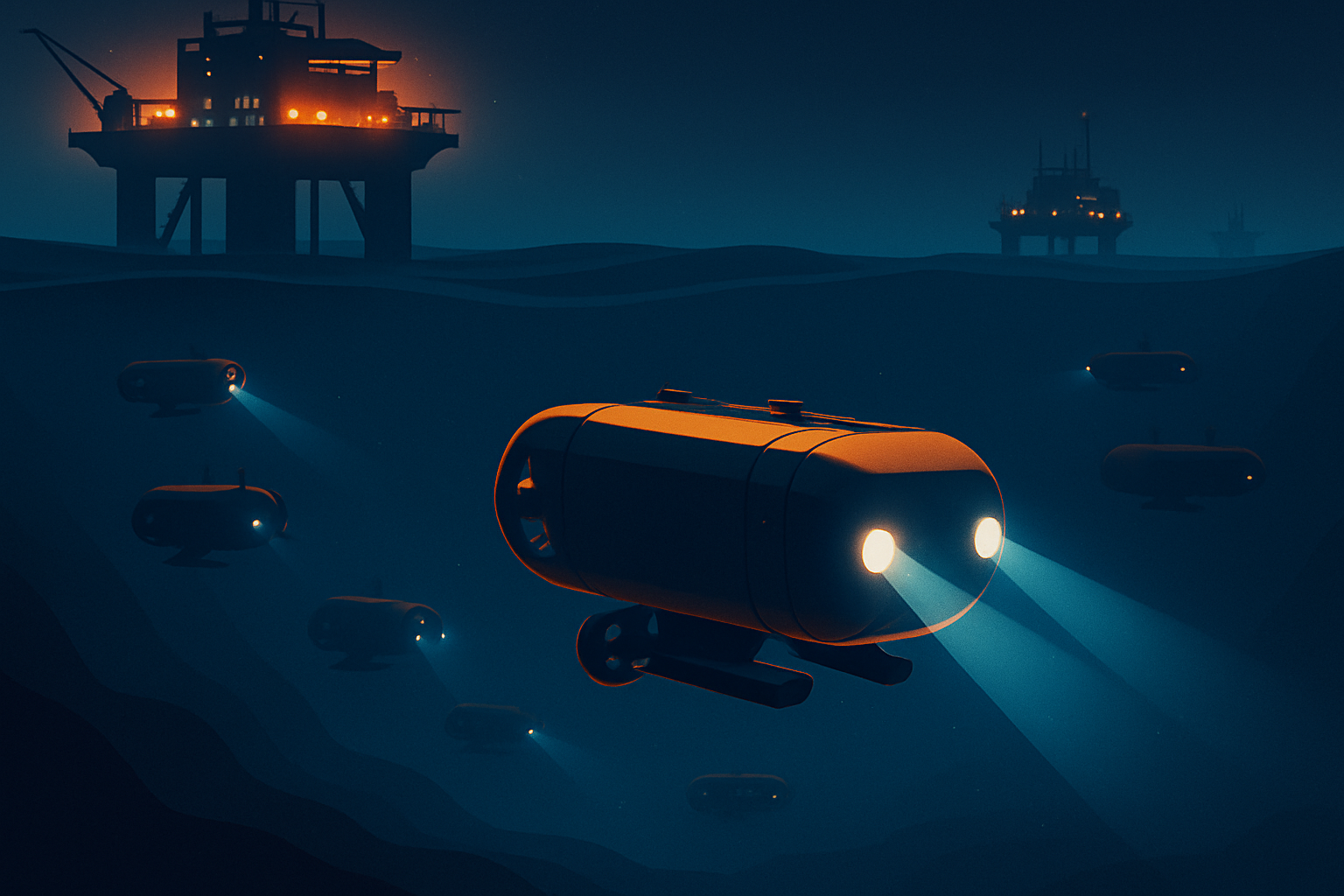
We've explained how underwater robots actually work in the Gulf of Mexico. This is the story of the industry behind them — a multibillion-dollar business that quietly made Houston the global capital of subsea robotics, and which is now reinventing itself for a world beyond oil and gas.
The Scale of It
Subsea robotics is not a niche. The global offshore ROV and AUV market is worth roughly $4.1 billion in 2026 and growing at better than 10% a year, on track toward an estimated $6.8 billion by 2030. Five companies command more than half of global revenue — and the two largest, Oceaneering International and TechnipFMC, are headquartered or deeply rooted in Houston, alongside global players Fugro, Subsea 7, and Saipem.
Oceaneering alone operates a fleet of more than 200 remotely operated vehicles across some 15 offshore regions worldwide — the largest commercial ROV fleet on the planet — supporting subsea interventions, pipeline inspections, and construction projects. When an offshore operator anywhere in the world needs a robot a mile underwater, there's a good chance the company providing it is run from Houston.
Why Houston Became the Capital
The cluster exists for the same reason Houston became the energy capital: the Gulf of Mexico. Decades of deepwater oil and gas development created a sustained, high-stakes demand for machines that could install, inspect, maintain, and repair infrastructure in environments no human can reach. That demand funded the engineering, built the talent pool, and concentrated the companies.
The result is a dense ecosystem within a short drive of each other: Oceaneering's headquarters, TechnipFMC's major subsea operations, Helix Energy Solutions' intervention business, and a generation of newer entrants like Webster-based Nauticus Robotics. Add the supply chain — sensor makers, tooling shops, simulation and training centers, and the offshore service vessels — and you have a self-reinforcing industrial base that's extremely hard to replicate anywhere else.
That concentration is a genuine competitive moat. A subsea robotics company benefits from being where the customers, the experienced pilots and engineers, the test facilities, and the deepwater operators all are. Houston has all of it.
The Technology Is Changing Underneath the Industry
The classic model — a tethered work-class ROV flown by a pilot from a crewed surface vessel parked overhead — is expensive, because the surface vessel is expensive. The industry's biggest engineering push is to reduce that surface dependency, and it's reshaping the hardware.
Oceaneering's Momentum all-electric work-class ROV, unveiled in March 2026, can deploy for up to 30 days at a time — a step toward "resident" robots that live on the seabed or on subsea docking stations and work on demand rather than being launched fresh for every job. Meanwhile companies like Nauticus are pushing autonomous and AI-driven vehicles (its Aquanaut platform) that aim to cut the surface-vessel requirement further still. The direction is unmistakable: more autonomy, more electric propulsion, more time underwater, fewer people on expensive boats.
The Pivot Beyond Oil and Gas
Here's the part that matters most for the industry's future. The subsea robotics expertise Houston built for oil and gas is increasingly valuable to industries that didn't exist at scale a decade ago — and the smart companies are diversifying into all of them:
- Offshore wind. As Europe and China lay thousands of kilometers of subsea power cable, those cables need inspection and maintenance — a market growing nearly 19% a year. The robots that inspect oil pipelines inspect wind-farm cables just as well.
- Critical minerals. Nauticus has repointed its autonomous vehicles toward deep-sea rare-earth and critical-mineral exploration, backed by a $250 million credit line — a bet that the seabed is the next frontier for the minerals that power batteries and electronics. (We covered that pivot in detail.)
- Defense. Navies and defense ministries are investing in seabed infrastructure protection, mapping, and undersea autonomy — work that maps directly onto commercial subsea robotics capabilities.
This diversification is what turns a cyclical oilfield-services business into a durable robotics industry. Deepwater oil and gas still anchors demand, but the same fleets and the same engineers are now serving wind developers, mineral explorers, and defense customers — shortening payback periods and smoothing out the boom-bust cycles that have always plagued energy services.
What It Means for Houston
Houston's subsea robotics base is one of the clearest examples of the city's broader robotics thesis: deep, hard-won expertise in operating machines in brutal environments, transferable far beyond the industry that created it. The robots built to survive a mile underwater in the Gulf are now relevant to the global energy transition, the critical-minerals supply chain, and national security.
It also means stable, high-skill jobs — ROV pilots, subsea engineers, software developers, simulation specialists — and a magnet for the next generation of underwater-robotics startups, who locate here for the same reasons the incumbents did. Explore the companies building this industry in our directory, or read our latest coverage of where it's heading.