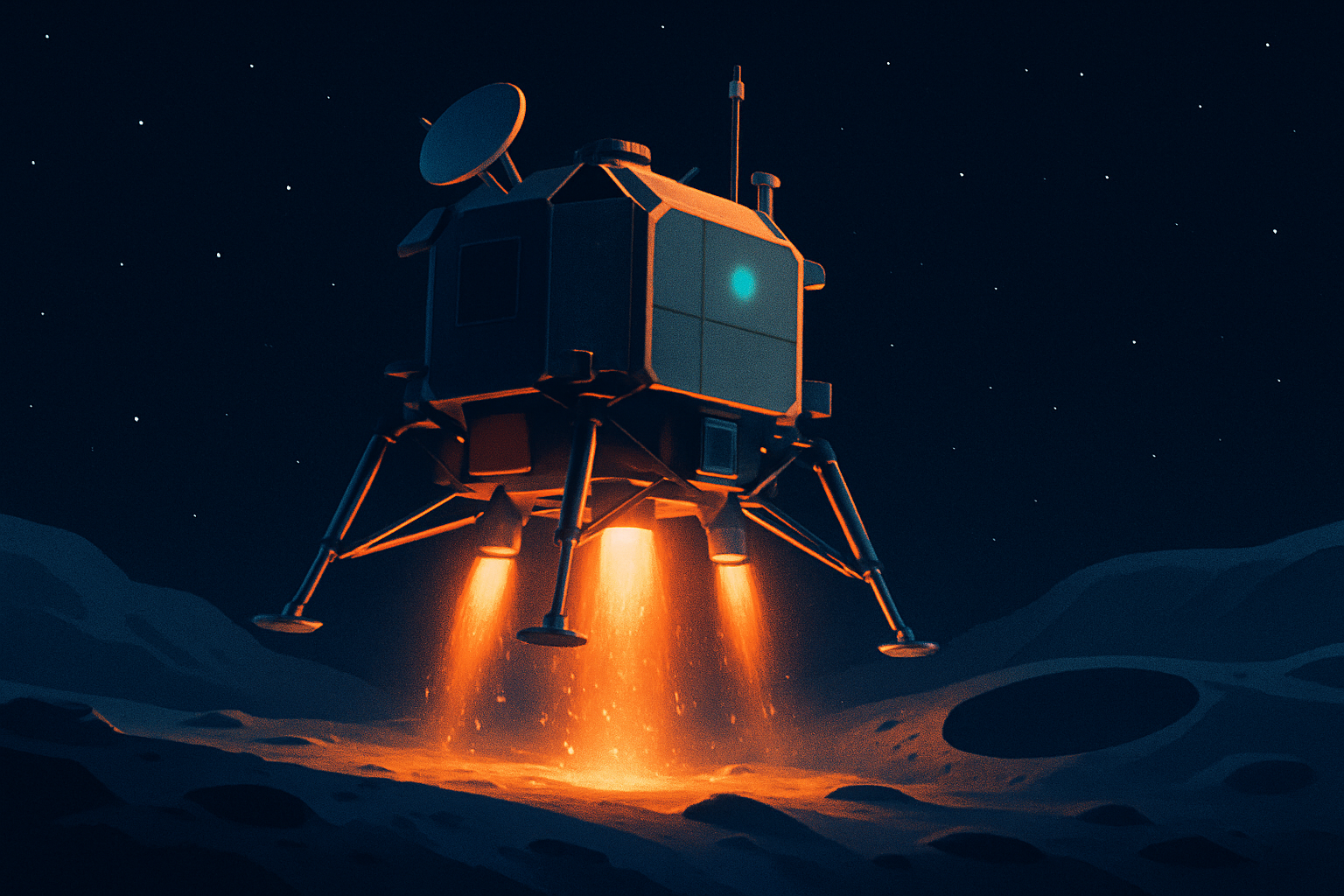
Houston's Intuitive Machines just added a major line to its lunar résumé: a $148.3 million award from NASA to help build the infrastructure for a Moon base. It's the company's sixth task order under NASA's Commercial Lunar Payload Services (CLPS) program, and part of a roughly $600 million allocation NASA split across three lunar-delivery companies.
What the Money Buys
The award funds the delivery of an Intuitive Machines Nova-C lander to the Moon by 2028, carrying three scientific and operational payloads: a Linear Energy Transfer Spectrometer (LETS) to monitor radiation, advanced stereo cameras (SCALPSS) to study how a lander's engine plume disturbs the lunar surface on touchdown, and a laser retroreflector array (LRA) that acts as a fixed positioning reference for cislunar navigation. The contract breaks down into a $68.6 million base and $79.7 million in performance incentives.
The plume-interaction cameras are more than a science curiosity: understanding exactly how rockets kick up abrasive lunar dust on landing is a core engineering problem for building anything permanent on the Moon — which is the whole point of a base.
The Real Story: Robotic Landers as a Product
The most telling detail is how CEO Steve Altemus framed it: "We are shifting the paradigm from custom aerospace engineering to commercial mass production." That's a robotics-and-manufacturing statement as much as a space one. Historically, every Moon lander was a one-off, hand-built science project. Intuitive Machines is betting the lunar economy needs the opposite — standardized, mass-produced robotic landers rolling off a line in parallel, the way a factory turns out any other complex machine.
That thesis connects directly to the company's robotics and mechanisms Center of Excellence and its in-house assembly and test capacity. A Moon lander is, fundamentally, a robot: it navigates, controls its descent, fires its engines, deploys mechanisms, and operates autonomously with no one aboard. Turning that robot into a repeatable product is the hard part Intuitive Machines is trying to industrialize.
Context and Competition
This award follows Intuitive Machines' $180.4 million CLPS contract in March 2026 for its larger Nova-D lander — so the company is stacking lunar-delivery business quickly. In the same NASA allocation, Austin's Firefly Aerospace received $144.2 million and Pittsburgh's Astrobotic $297.9 million, underscoring that commercial lunar delivery is now a real, competitive market rather than a single-winner program. NASA's targeted Moon base, near the lunar South Pole, is aimed at completion after 2032.
Why It Matters for Houston
Intuitive Machines is one of the anchors of Houston's commercial-space cluster — headquartered at the Houston Spaceport, and the first commercial company to soft-land on the Moon. Each new award deepens the region's position not just as the home of Mission Control, but as a place where the robotic hardware of lunar exploration is designed, built, and increasingly mass-produced. It sits alongside the deep space-robotics expertise at NASA's Johnson Space Center just down the road — the public and commercial halves of the same Houston strength.
Reporting based on coverage by InnovationMap. Original story: innovationmap.