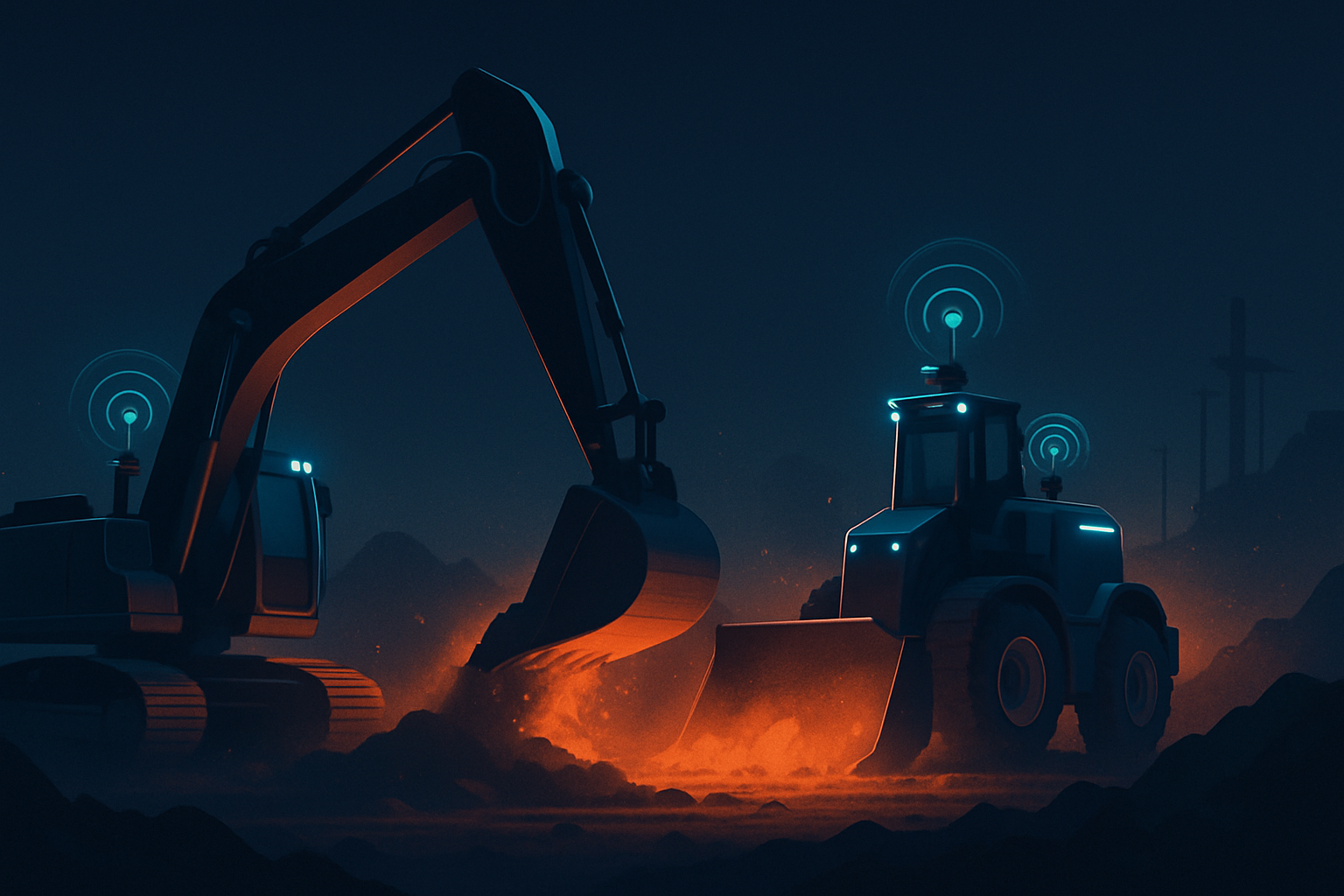
Manufacturing got robots decades ago. Warehouses got them in the 2010s. Construction — a multi-trillion-dollar global industry with chronic labor shortages and famously flat productivity — has stayed stubbornly manual. That is finally changing, and the money says it's changing fast.
The Funding Wave
The scale of investment tells the story. Bedrock Robotics, founded by ex-Waymo engineers to retrofit heavy machinery with autonomy, raised a $270 million round that pushed its total past $350 million at a $1.75 billion valuation. TerraFirma raised over $100 million in a Series A to turn construction equipment into robots. Xpanner raised $18 million for "automation as a service" on job sites, and ETH spinout Gravis Robotics raised $23 million to automate earthmoving. In an already record-setting year for robotics funding, construction has become one of the hottest sub-sectors.
What's notable is how many of these companies converge on the same strategy: retrofit, don't rebuild.
Why Retrofit Beats Building New
There are already millions of excavators, dozers, loaders, and graders working on job sites worldwide, and they're extremely good at their jobs — durable, powerful, serviceable, and backed by dealer networks. Building a purpose-built autonomous machine from scratch means recreating a century of heavy-equipment engineering just to get to the starting line.
The retrofit approach instead bolts an autonomy kit — sensors, compute, and actuators — onto proven off-the-shelf machines. The robot is the brain, not the body. That slashes capital cost, lets contractors keep their existing fleets and maintenance relationships, and means the startup can focus entirely on the hard part: perception and control in an environment that changes by the hour.
Why Construction Is So Hard
If it were easy it would already be done. Construction sites are the opposite of a factory floor in nearly every way that matters to a robot:
- The environment is unstructured and changes constantly. A factory cell is identical every cycle. A job site is different every single day — by design, since the whole point is to change the terrain.
- The terrain itself is the workpiece. An excavator doesn't just move through the world, it reshapes it. The robot must reason about soil, slope, and material behavior, not just navigate around obstacles.
- Conditions are brutal. Dust, mud, vibration, rain, extreme heat, and GPS-degraded areas near structures all punish sensors that work fine indoors.
- People and machines share the space. Heavy equipment operating near ground crews raises the safety bar dramatically — the failure mode isn't a dropped part, it's a fatality.
Those constraints are precisely why the payoff is large. Automating a task this hard means the underlying autonomy stack is robust enough to be valuable almost anywhere.
Where Houston Fits
The best-funded construction-robotics startups are mostly based elsewhere, but Houston has a genuine stake in this frontier — and a distinctive one.
Rugged Robotics is the clearest local example. Rather than automating earthmoving, it attacks a different bottleneck: layout. Translating a building's digital plans into physical markings on a concrete slab is tedious, error-prone manual work that determines where every wall, conduit, and fixture goes. Rugged's robot drives the slab and marks the layout directly from the model — a narrower target than a self-driving excavator, but a real, shipping product solving a real cost center.
The city's deeper advantage is adjacent expertise. Houston has spent decades building robots for the hardest physical environments on earth — a mile underwater in the Gulf, inside refinery tanks, on hazardous industrial sites. The engineering discipline that makes a subsea ROV survive is directly relevant to making a machine survive a job site. And the region's enormous industrial construction pipeline — plants, terminals, and energy infrastructure — is a natural proving ground and customer base.
What to Watch
The near-term reality is narrower than the headlines suggest. Expect autonomy to land first on repetitive, well-defined tasks in controlled parts of a site — grading a pad, hauling along a fixed route, layout marking — with human operators supervising rather than being replaced. The fully autonomous job site remains distant.
But the direction is clear, and the capital flowing in is real. Construction robotics is following the same arc as autonomous trucking: years of skepticism, then a sudden shift from demos to commercial deployment once the economics clear. For Houston — a city that builds constantly and knows hard-environment robotics — it's a frontier worth watching closely. Explore local companies in our directory.
Funding figures reflect publicly reported rounds from construction-robotics industry coverage.