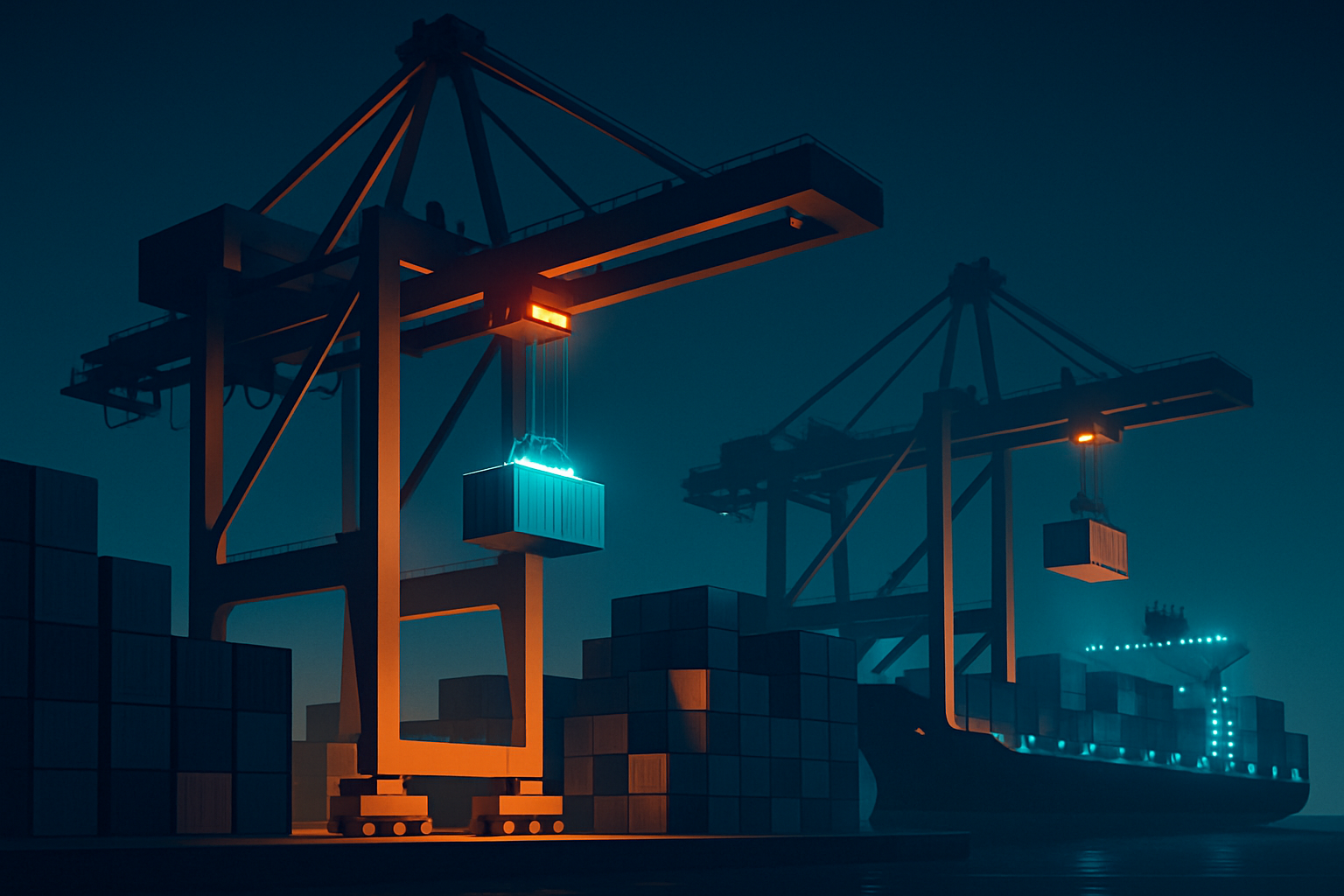
Some of the largest working machines in Texas aren't in a refinery or a shipyard — they're the towering cranes lining the Houston Ship Channel. Port Houston has become the fifth-largest container port in the United States, handling a record 2.23 million TEUs in the first half of 2026 alone — its strongest first half ever, after closing 2025 at 4.3 million TEUs — and it's been steadily investing in the cranes, systems, and automation needed to keep that volume moving. Here's what's actually automated at the port, what isn't, and why the distinction matters.
The Machines
Container terminals run on two families of giant machines. Ship-to-shore (STS) cranes are the enormous structures that reach out over a docked vessel and lift containers on and off. Rubber-tired gantry cranes (RTGs) work the yard behind the wharf, stacking containers and loading them onto trucks.
Port Houston has been expanding both fleets aggressively. As of mid-2026 the port completed commissioning of four additional STS cranes at Bayport Container Terminal, bringing that terminal to 21 ship-to-shore cranes. On the yard side, the final six of sixteen RTGs ordered in 2025 were delivered in March, pushing the combined fleet across both container terminals to 163 RTGs.
What's Actually Automated
This is where nuance matters. Port Houston is not a "lights-out" automated port of the kind operating in parts of Asia and Europe, where driverless vehicles shuttle containers with almost no one on the ground. What Port Houston has been deploying is more targeted — and arguably more pragmatic.
The port rolled out RTG automation in 2025, adding automated control to the yard cranes that stack and retrieve containers. Combined with the new wharf and crane assets, port officials credit these upgrades with boosting yard productivity and improving truck turn times — the metric that most directly determines how long a trucker waits to pick up a container, and one of the clearest measures of a terminal's efficiency.
Yard-crane automation is a smart place to start. The stacking task is repetitive and geometrically well-defined — exactly what automation handles well — and it can be introduced incrementally without re-engineering the entire terminal or displacing the skilled crane operators who work the ship side, where conditions are far more variable.
The Capital Behind It
The automation sits inside a much larger infrastructure program. Port Houston is investing roughly $650 million in capital improvements at Barbours Cut Terminal across 2023–2027, including reconstruction of wharves to accommodate larger cranes and bigger vessels. At Bayport, the commission approved construction of Wharf 1 — 1,300 additional linear feet of berth, scheduled for completion in 2028, and slated to be fitted with the largest cranes the port has ever operated.
That sequencing is deliberate: heavier wharves and bigger cranes first, because you cannot automate capacity you don't physically have. Bigger ships require bigger cranes, which require stronger wharves — and automation multiplies the productivity of that hardware rather than substituting for it.
Why Ports Automate Cautiously
Port automation has a mixed track record globally. Some fully automated terminals have delivered impressive consistency and safety gains; others have struggled with cost overruns and throughput that lagged the skilled human operations they replaced. Ports are also deeply unionized workplaces where automation is a significant labor issue, and terminals cannot simply shut down for a rebuild — they have to keep moving cargo throughout.
The incremental path — automate the yard cranes, upgrade the wharves, add capacity, improve the software layer — lets a port capture real productivity gains without betting the terminal on a single transformation. Given that Port Houston's volumes are growing fast enough to push it into the U.S. top five, keeping cargo flowing while upgrading is not a small constraint.
Why It Matters for Houston
The port is the hinge between Houston's industrial economy and the world, and it sits at the intersection of several automation stories we track. The containers those RTGs stack are increasingly moved inland by autonomous trucks running the Texas freight triangle — Houston is the southern anchor of that network. The port's own equipment reflects the same industrial-robotics competence that shows up across the region's subsea and refining sectors.
As volumes climb and vessels get larger, expect the automation layer to keep thickening — more automated yard equipment, better optimization software, and tighter integration with the trucking and rail networks beyond the gate. Explore Houston's automation companies in our directory.
Figures reflect Port Houston commission reports and maritime trade coverage through mid-2026.