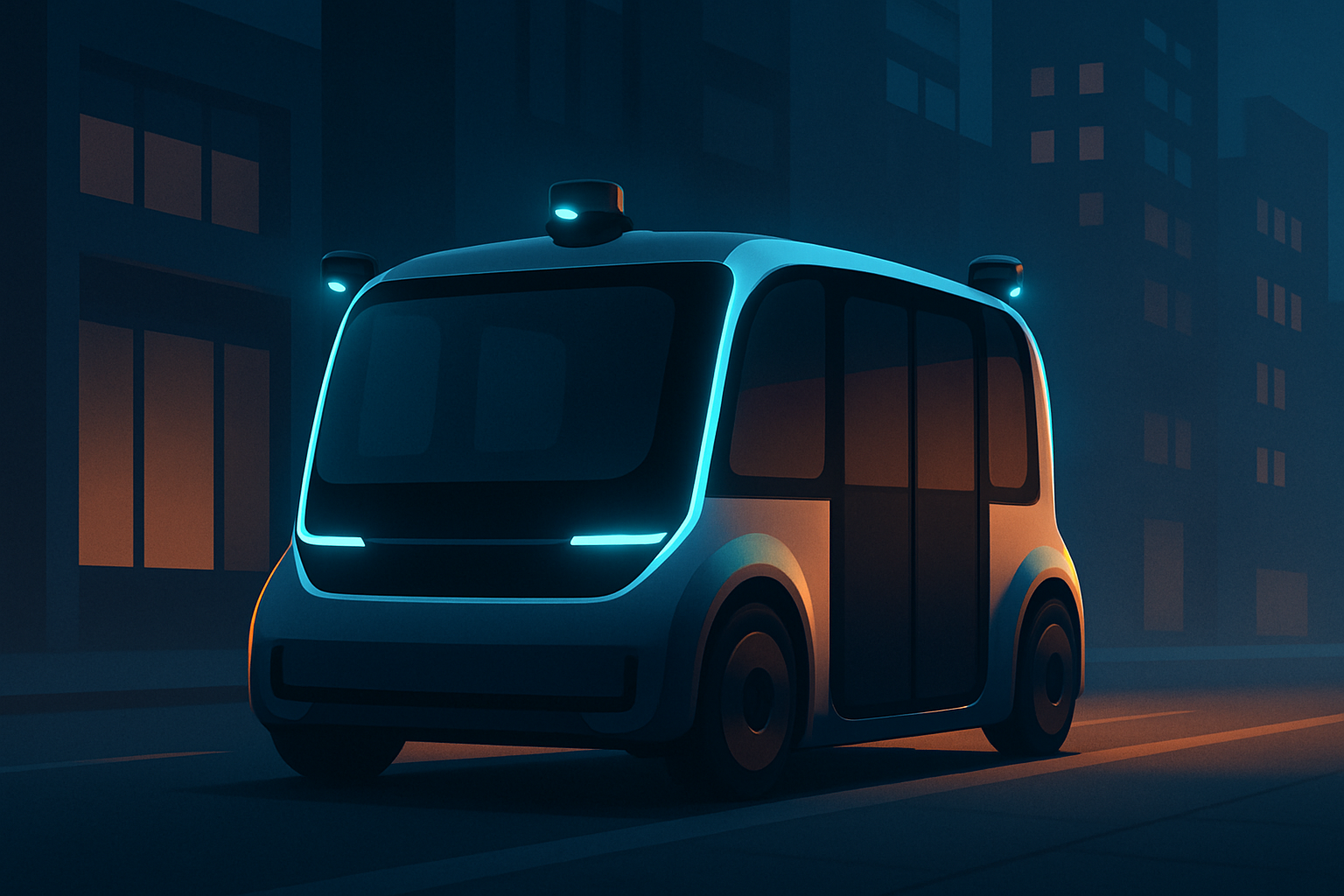
Houston's robotaxi field just added its most unusual entrant. Zoox, owned outright by Amazon, has started operations in the city — and unlike every competitor here, its endgame vehicle has no steering wheel, no pedals, and no driver's seat.
A Different Kind of Vehicle
Most autonomous ride-hail companies bolt a sensor and compute stack onto an existing car. Waymo runs modified Jaguars; the Uber-Nuro partnership uses Lucid EVs. Zoox took the harder path: a purpose-built robotaxi designed from scratch for autonomous ride-hailing, with no traditional driving controls, carriage-style seating where riders face each other, and sliding glass doors.
That design choice is a real bet. Building a vehicle from the ground up means clearing regulatory ground that doesn't exist for retrofits — a car with no steering wheel doesn't fit neatly into federal motor vehicle safety standards written on the assumption a human drives. The upside is a cabin optimized for passengers rather than one apologizing for the missing driver.
The Rollout
Zoox is starting the way these programs usually do: retrofitted SUVs with safety drivers, collecting mapping and behavioral data across the city before the purpose-built vehicles operate autonomously. Initial coverage targets downtown Houston, tourist destinations, and select residential neighborhoods, and the company plans a Houston depot for charging and maintenance.
Notably, Zoox describes Houston as its most sprawling market to date — and names the specific difficulty: the region's complex service-road system alongside its freeways, plus challenging environmental conditions. Anyone who has tried to explain a Texas frontage road and its U-turn lanes to an out-of-towner will recognize the problem. It is a genuinely awkward geometry for an autonomous driving stack, and one that barely exists in the Bay Area or Phoenix where these systems were largely trained.
Houston Is Now a Four-Way Race
The city has quietly become one of the most contested autonomy markets in the country:
- Waymo — operating since early 2026, after briefly suspending service during flooding
- Tesla — running its own robotaxi effort in the market
- Zoox — testing now, with purpose-built vehicles to follow
- Uber + Nuro + Lucid — a premium service targeted for 2027
Four operators with four different strategies — retrofit versus purpose-built, owned fleet versus platform partnership — all validating against the same difficult city. That concentration is itself informative: Houston's sprawl, weather, and road complexity have gone from a reason to avoid the market to the reason to prove yourself in it.
The Broader Autonomy Picture
Robotaxis are the consumer-facing edge of the same stack reshaping the region's industrial base. The perception, planning, and control problems Zoox is solving on Houston service roads are cousins of what Bot Auto and others solve for autonomous freight on Texas interstates, and what drives inspection robots through refineries and the Gulf.
The difference is visibility. Most of Houston's robotics runs out of public view — underwater, inside tanks, on factory floors. A driverless vehicle with no steering wheel picking someone up downtown is the version residents will actually see. Explore the region's autonomy companies in our directory.
Reporting based on coverage by InnovationMap. Original story: innovationmap.